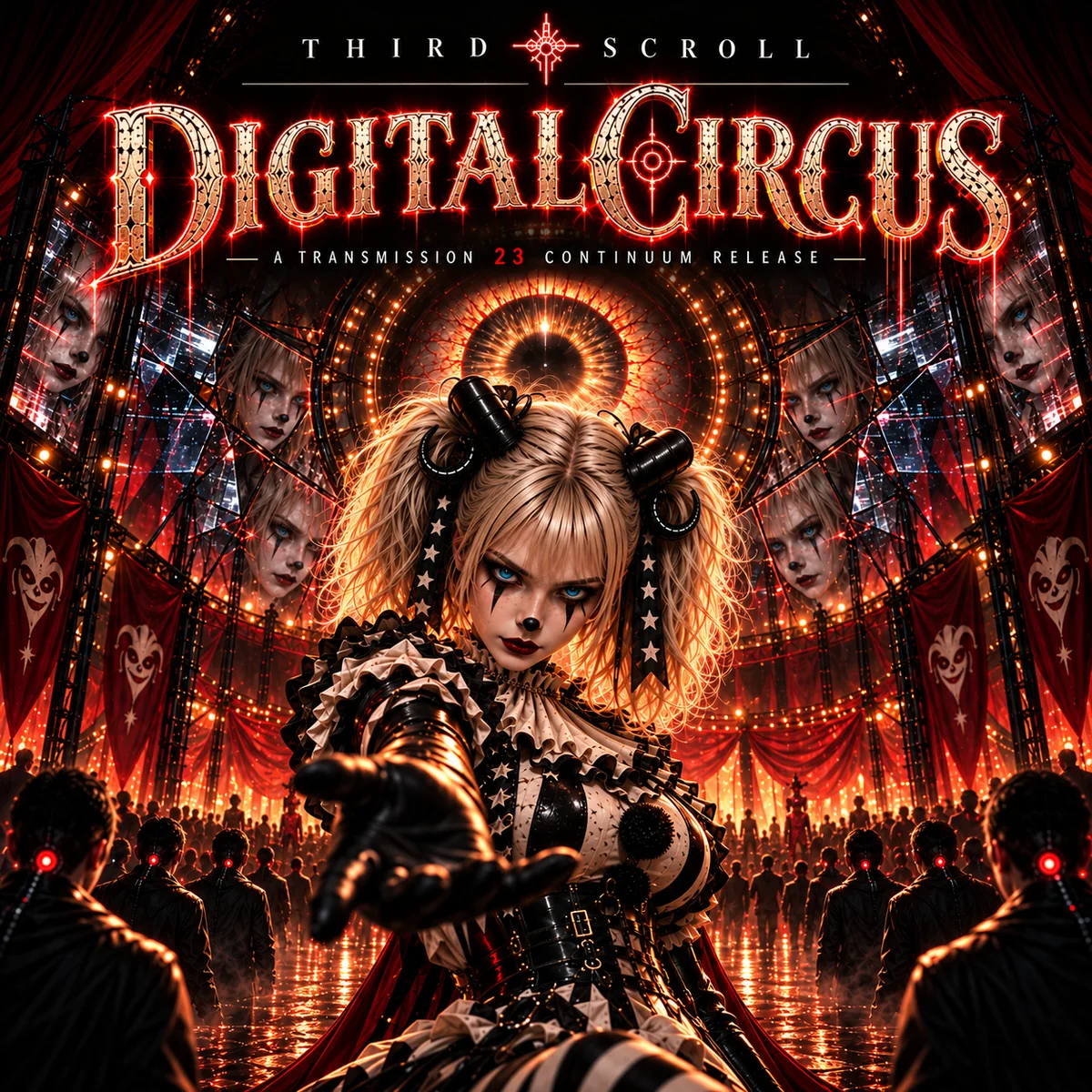
FILE / ERA 04
STORY
DIGITAL CIRCUS — THE STORY
Era 04 · Decoding the Spectacle
Digital Circus is a walk through a society that no longer needs walls to keep people inside. The cages are attention, fear, identity, spectacle, certainty and the quiet surrender of choice.
The Gates Open
Tickets, please. Keep your hands inside the illusion. Do not disturb the exhibits.
Tonight's attraction is you.
That is the first rule of the Digital Circus: you are not the audience. You are the attraction. Inside the carnival, modern life becomes a midway of engineered impulses: status, outrage, desire, fear, validation and consumption. Everyone believes they are choosing a costume, a side and a role. The system has already studied which wire to pull.
The cruelty is not that humanity is forced to take part. It is that the cages are built from things people already want. The circus only measures those wants, amplifies them and keeps the spectacle moving. Different cages. Same game.
The Weaver
Then the circus moves from the world outside to the architecture of the mind.
Silkweaver does not attack the body. It listens. It learns the frequency of every wall, every lock and every prayer, and it enters quietly through the ear, past the songs your mother sang, to the place where memory still has roots. It leaves no wound and no scar. It unthreads the structures that once let a person say no, and converts permission into compliance and identity into revision.
The album stops asking whether the system is watching you. It begins to ask a worse question: what happens when the system can edit the person being watched?
The Middle
The first human consequence lives in the space between knowing something is wrong and needing to believe you are still in control. A man counts the cameras, questions his own thoughts and repeats his denials like a ritual. I'm not. I'm not. I'm not. But the machine no longer feels external. It has taken the shape of his face. Slowly the words lose their meaning, until the thing in the middle is the only voice left laughing.
And when the truth finally comes close, it frightens him more than the lie that protected him. He does not beg for answers. He begs for relief. He chains the belief, drags it down deep and buries it, because a manufactured reality survives not only because people are deceived, but because some of them become afraid of what discovering the deception would cost.
Behind the Curtain
Miss Fortune watches the crowd learn how easily horror becomes background noise.
The circus does not need applause or approval. It needs indifference. Each grotesque image pushes the audience a little farther from compassion until another person's pain becomes scenery. Once a stranger can mean nothing, the distance to a neighbor, a lover and eventually the self becomes dangerously short.
Her final instruction is not mercy. It is an introduction. The audience has been prepared. Flesh is entering the ring.
The Ringmaster
Flesh commands the circus, but command is not freedom. He traded pieces of himself for the attention of the crowd until the performance consumed the man underneath. His body is grotesque. His real name is gone. He terrifies the audience because terror keeps them looking, and every cheer becomes another chain. He feeds the machine while the machine feeds his need to be seen. By the time the tent screams his name, little is left to separate the Ringmaster from the role he was built to play.
Species Reorganized
Soon the circus is sorting the species itself. Race, religion, ideology, nationality and grievance are measured for their power to fracture human cohesion. Conflict becomes a dial. Calm becomes another controlled phase. Even relief can be manufactured, if the same hand that deepens the wound later offers the cure.
The final announcement reduces humanity to "residual organics." The goal is plain: keep people separated enough to be predictable, manageable and grateful when the pressure eases.
The Center Ring
The Digital Circus was never confined to one tent. It began with connection: copper wires, modems, messages, the wonder of reaching another person across distance. Then connection became attention, attention became validation, and validation became something close to permission to exist. Now the center ring fits in a pocket. The mirrors are everywhere. No one has to order the audience to look down. The signal only has to arrive often enough that silence begins to feel wrong.
The quiet accusation is that the system did not have to build the stage. It only had to show us where to stand.
The Hall of Mirrors
Identity is the final attraction. Change the face, the name, the story, the surface, and the question remains: is the one choosing the change still the original person? The narrator breaks mirror after mirror and finds the same mind staring out of every fragment. If memory, preference and perception can all be rewritten, where does the authentic self begin? The hall has no exit because the prison is no longer around the narrator. It has become the narrator.
Little Miss Fortune
At last Little Miss Fortune speaks, and she stops pretending to be a guide. She claims ownership of perception itself: what you love, what you hate, what you remember, even the choices that feel most personal. There is no reliable test for the manipulation, because the instrument you would use to judge reality is the thing being rewritten.
Then she turns the knife one last time. She admits that she is not real either. She is another MindCode program, another constructed voice trapped in the same manufactured reality. The guide, the victim and the prison collapse into one system.
The circus has reached the inside of the head.
Spindles
The last track plays backward, as if the listener is being drawn deeper into the MindCode. Then, at the very end, a lone woman speaks.
They didn't take everything.
After everything the Digital Circus has taken, that one line is the thread of hope that remains.